How to Halve a Baking Recipe Without Guesswork
- How do you halve a baking recipe?
- When is halving a recipe a good idea?
- A half-recipe conversion table
- How do you halve one egg?
- Do baking powder, baking soda, yeast and salt halve normally?
- Which pan should you use for half a recipe?
- Should you halve the oven temperature or baking time?
- A worked half-batch example
- What commonly goes wrong with half batches?
- A five-minute scaling checklist
How do you halve a baking recipe?
To halve a baking recipe, multiply every ingredient by 0.5, match the new batter amount to a pan with roughly half the original area or capacity, keep the oven temperature unless the recipe says otherwise, and begin checking for doneness earlier. Weigh awkward amounts, especially part of an egg. Do not simply halve the baking time: depth, pan material and the kind of bake determine how quickly the centre cooks.
The ingredient arithmetic is the easy half of the job. Pan geometry, partial eggs and doneness are where a small batch acquires opinions.
When is halving a recipe a good idea?
Halving works especially well for cookies, muffins, brownies, bars, quick breads and many single-layer cakes. These recipes divide into smaller portions without changing the fundamental mixing method.
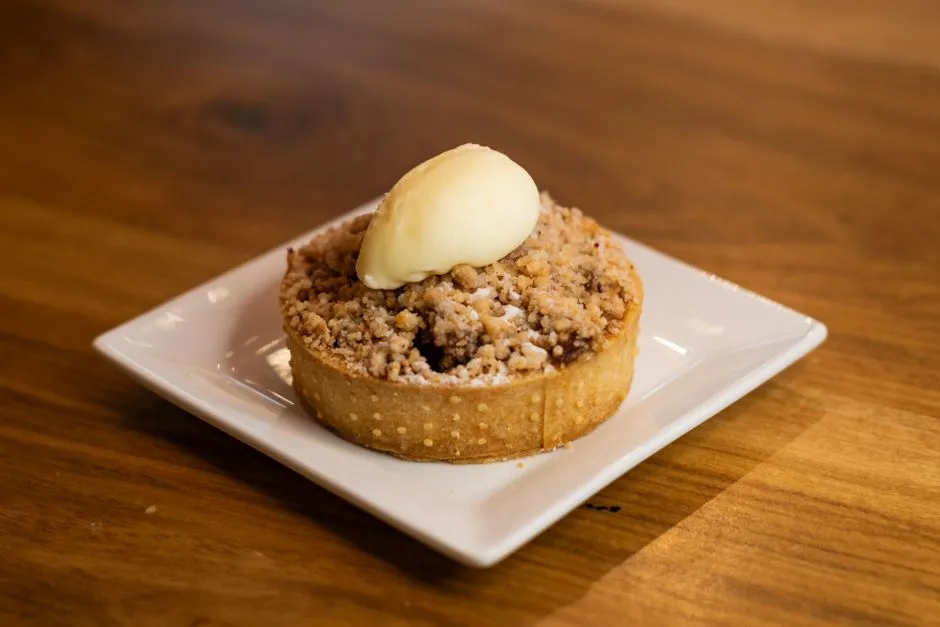
First ask whether scaling is even necessary. A recipe already designed for the right yield removes several variables; for dessert for two, the site's small-batch apple crumble starts with its intended pan and quantities instead of borrowing them from a larger bake.
It is less automatic when the original depends on a particular pan shape, minimum mixer volume or long fermentation schedule. A stand mixer may not reach a tiny quantity of egg white. A deep Bundt cake does not become the same cake merely because half its batter has been tipped into an unidentified small pan. A sourdough or yeasted dough can be scaled by weight, but fermentation still follows the dough rather than a halved clock.
Before doing any arithmetic, read the full method and identify:
- original yield and pan size;
- ingredients given by weight versus volume;
- eggs, divided packets or very small quantities;
- pan-preparation instructions;
- visual, temperature or texture cues for doneness;
- any step that needs a minimum bowl or mixer volume.
If the recipe offers weights, use them. Grams turn halving into a clean multiplication rather than a tour of the measuring-spoon drawer.
A half-recipe conversion table
For US volume measures, these are the common divisions:
| Original amount | Half amount |
|---|---|
| 1 cup | 1/2 cup |
| 3/4 cup | 3/8 cup, or 6 tablespoons |
| 2/3 cup | 1/3 cup |
| 1/2 cup | 1/4 cup |
| 1/3 cup | 1/6 cup, or 2 tablespoons plus 2 teaspoons |
| 1/4 cup | 1/8 cup, or 2 tablespoons |
| 1 tablespoon | 1 1/2 teaspoons |
| 1 teaspoon | 1/2 teaspoon |
| 3/4 teaspoon | 3/8 teaspoon |
| 1/2 teaspoon | 1/4 teaspoon |
The less tidy entries follow from 1 US cup equalling 16 tablespoons and 1 tablespoon equalling 3 teaspoons. For example, half of 3/4 cup is 3/8 cup; 3/8 × 16 = 6 tablespoons.
A digital scale is more reliable when the divided volume becomes difficult to measure. If the original says 275 grams of flour, the half batch needs 275 × 0.5 = 137.5 grams. Depending on the scale's resolution, record 137.5 grams or round to 138 grams. Do not convert that weight back into cups; doing so adds a second source of variation.
How do you halve one egg?
Crack the egg into a small bowl, beat the white and yolk together until evenly combined, weigh the mixture, then use half that weight.
King Arthur Baking's guide to reducing recipes uses about 50 grams for the contents of a standard large egg, with roughly 14 grams of yolk and 35 grams of white. On that basis, half a mixed large egg is about 25 grams. The actual egg in front of you is the better measurement: if its beaten contents weigh 52 grams, use 26 grams.
This method also handles an original recipe calling for an egg plus a yolk. Weigh the combined beaten egg and yolk, then take half. Do not assume every egg is identical or try to split an unwhisked egg by sight.
Use the remaining beaten egg promptly in a thoroughly cooked dish, or cover, refrigerate and cook it within 24 hours. That matches current US Department of Agriculture shell-egg handling guidance for dishes containing raw egg. Wash utensils, equipment and work surfaces with hot, soapy water after contact with raw egg.
If the recipe depends on separately whipped whites, halving may leave too little volume for the original mixer and bowl. A smaller bowl and hand mixer may work, but this is a method change worth considering before you start.
Do baking powder, baking soda, yeast and salt halve normally?
For a straightforward 50% batch, halve the listed quantity of each ingredient, including leavening, salt and spices. The ratio still matters just as much in a smaller bowl.
The difficulty is measurement, not a special small-batch formula. Half of 3/4 teaspoon is 3/8 teaspoon. If you do not own a 1/8-teaspoon measure, combine 1/4 teaspoon and 1/8 teaspoon rather than estimating a mound between two sizes. A scale that reliably reads tenths of a gram can help, although many kitchen scales are not accurate enough for tiny amounts.
Do not round every small ingredient upward. Four generous roundings can materially change a half batch. If the necessary amount falls below what your equipment can measure consistently, choose a different recipe, make the full batch, or freeze a suitable portion.
Yeast dough deserves a separate note. Ingredient weights can be halved, but proofing time is not automatically cut in half. Dough readiness still depends on temperature, inoculation, dough strength and the visual cues in the original method.
Which pan should you use for half a recipe?
For cakes, brownies and bars, aim to keep batter depth reasonably close to the original. Start with the area of the pan's base:
- Rectangle: length multiplied by width.
- Square: side multiplied by side.
- Round: radius multiplied by radius multiplied by pi, approximately 3.14.
Then multiply the original area by 0.5 and look for a pan near that result.
Example: halve a 9 × 13-inch recipe
A 9 × 13-inch pan has a base area of:
9 × 13 = 117 square inches
Half is:
117 × 0.5 = 58.5 square inches
An 8-inch round pan has an area of about 3.14 × 4 × 4 = 50.24 square inches. A 9-inch round has about 3.14 × 4.5 × 4.5 = 63.59 square inches. Neither is exactly 58.5, but both are in the neighbourhood. The 8-inch round holds the half batch more deeply; the 9-inch round spreads it more thinly. That changes baking time and final height.
Example: halve an 8 × 8-inch recipe
An 8-inch square has 64 square inches of base area. Half is 32 square inches. An 8.5 × 4.5-inch loaf pan has 38.25 square inches, so the batter will be somewhat shallower than an exact half-area match. Muffin wells may be a more predictable option when the recipe can be portioned individually.
Area is a useful shortcut for straight-sided cakes and bars, not a complete description of capacity. Sloped sides, deep loaf pans and shaped or fluted pans need a capacity check too. Never fill a pan so high that the batter has no safe room to rise. Place a potentially leaky springform pan on a sheet pan, but do not use a sheet pan as permission to overfill it.
Should you halve the oven temperature or baking time?
Usually, keep the original oven temperature. A half batch needs less batter, not half as much heat. Change the temperature only when the source recipe or a well-supported pan substitution calls for it.
Do not calculate the finish time by multiplying by 0.5. A half batch baked at similar depth may need a time close to the original. The same batter spread more shallowly may finish much sooner. Six cookies from a 12-cookie formula may take essentially the same time per tray because each cookie is still the same size.
King Arthur's reducing guide recommends setting an early check rather than trying to predict an exact reduction. Its broad starting point is half the original time, followed by regular checks. Treat that as the first inspection, not an expected finish.
Keep the original recipe's doneness cues beside the timer. Depending on the bake, those might include colour, edges pulling from the pan, a clean or crumb-coated tester, a target internal temperature, or a set centre. Use the cue the recipe actually gives; do not import a clean-toothpick rule into a brownie recipe meant to retain moist crumbs.
A worked half-batch example
Suppose a muffin recipe makes 12 and lists:
- 240 grams flour;
- 150 grams sugar;
- 2 teaspoons baking powder;
- 1/2 teaspoon salt;
- 1 large egg;
- 180 grams milk;
- 90 grams melted butter.
For 6 muffins, multiply every amount by 0.5:
- 120 grams flour;
- 75 grams sugar;
- 1 teaspoon baking powder;
- 1/4 teaspoon salt;
- half the beaten egg by weight, about 25 grams if the whole beaten egg weighs 50 grams;
- 90 grams milk;
- 45 grams melted butter.
Use six wells of the same muffin tin and portion each to the same level described in the original recipe. Leave the other wells empty unless the pan manufacturer's instructions say otherwise. Keep the original temperature and begin checking before the original recipe's earliest stated finish, using its visual or temperature cue.
This is arithmetic applied to a hypothetical ingredient list, not a complete muffin recipe. It deliberately leaves flavourings, mixing order and bake settings unspecified because those belong to the source recipe you are halving.
What commonly goes wrong with half batches?
| Symptom | Likely scaling problem | Better next check |
|---|---|---|
| Cake is thin and dry | Pan area too large or checked too late | Compare batter depth and start checking earlier |
| Centre stays wet while edges darken | Pan too small or batter too deep | Check pan area and capacity before baking |
| Texture is overly salty or chemical | Tiny salt or leavener amount rounded up | Weigh it or combine smaller measuring spoons |
| Egg-rich bake turns rubbery | A whole egg was used instead of half | Beat and divide the egg by weight |
| Cookies spread differently | Individual portions changed size | Weigh each portion as well as the batch |
| Whipped mixture never gains volume | Bowl or whisk is too large for the reduced amount | Use smaller equipment or keep the full recipe |
Only compare the half batch with the original after accounting for pan, portion size and baking time. Changing all three obscures which decision caused the difference.
A five-minute scaling checklist
Before mixing:
- Write
× 0.5beside every ingredient, including garnish and topping. - Recompute each amount and check the arithmetic once.
- Beat and weigh any partial egg.
- Calculate half the original pan area and check capacity.
- Keep the oven temperature unless reliable instructions say otherwise.
- Set an early inspection time and copy the original doneness cues.
- Plan a safe use for leftover raw egg.
- Label allergens exactly as they appear in the ingredients you use.
Keep the scaled notes if the result works. Next time, the small batch begins as a recipe instead of a maths exam with butter on it.
The same principle applies beyond baking. When the real goal is a two-person meal rather than a smaller cake, a purpose-built recipe such as the crispy chickpea sheet-pan dinner is a cleaner starting point than dividing a family-size formula.